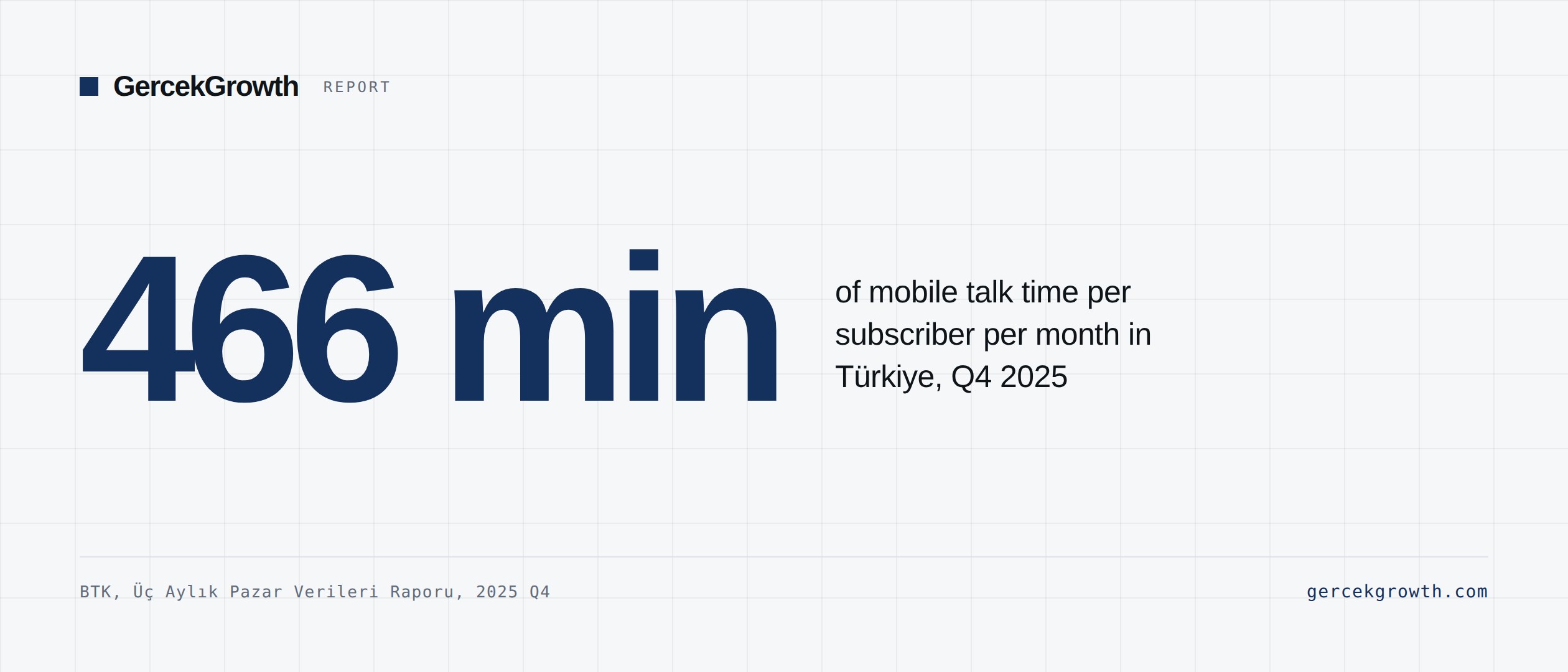
Short answer: No cold email or cold call benchmark is published for Türkiye. The soundest global figures we have are from 2025: roughly 4.5 replies per 1,000 cold emails sent, 9.9% of dials connect, and about 370 dials per meeting booked (Belkins, 7.5 million emails and 175,000+ dials). Türkiye's own measured number is on the phone side: 466 minutes of mobile talk time per subscriber per month (BTK, Q4 2025). On the legal side two rules decide whether a campaign is lawful: merchants and tradesmen need no prior consent, but their addresses must be loaded into İYS before you send, and consent under Law 6563 does not discharge the KVKK obligation.
Why no benchmark exists for Türkiye
Every source that publishes cold email and cold call benchmarks publishes from its own client base, and that base is overwhelmingly the US, the UK and Western Europe. Belkins' 2025 dataset has a country breakdown and Türkiye is not in it. Neither is it in Instantly's, Lavender's or Gong's.
The parties that do publish Turkish data are the email service providers, and what they publish is opted-in B2C newsletter traffic: e-commerce campaigns, coupon sends, membership announcements. That is a different business from cold B2B sending. Putting the two numbers in the same table means misreading both.
The practical consequence: if someone tells you the cold email open rate in Türkiye is some particular percentage, they are either relabelling a global figure or presenting newsletter data as cold outbound. There is no third possibility, because there is no third measured source.
The global numbers, and how to read them
The most transparent methodology published is Belkins': 7,530,489 emails across 2025, 34,393 replies. Average reply rate 0.45%. The figure looks low because replies are divided by total emails sent, not by opens.
That methodology change matters. Belkins turned open tracking off entirely in 2025. Apple's image preloading and corporate security scanners made open data unusable: an email can be marked opened without a human ever reading it. A tool reporting a 55% open rate may be reporting scanner traffic.
The breakdowns in the same dataset are about targeting far more than about copy:
- By seniority: founders and owners 0.57%, C-level 0.42%, VPs 0.32%
- By company size: 0 to 10 employees 0.72%, 11 to 50 employees 0.49%, 10,000+ employees 0.22%
- By month: February highest at 0.54%, December lowest at 0.35%
- By country: Poland 1.43%, Ireland 0.74%, US 0.51%, UK 0.48%
The gap between the smallest companies and the largest is more than threefold. Which means who you write to decides more than what you write. Fixing the list pays more than fixing the copy.
The global numbers on the calling side
From the same source's 175,000+ dials logged across 2025: 9.9% connect rate per dial, 24.5% per prospect across multiple attempts. 58% of connects become real conversations, 4.6% of conversations become meetings. End to end, about 370 dials per meeting booked.
The distance between 9.9% and 24.5% is the one-line case for multiple attempts. Call a prospect once and stop, and you reach roughly a third of the people you could have reached. That is usually what teams have measured when they conclude cold calling does not work.
Calls that book a meeting run 3.7 minutes on average. The goal is not a long pitch. It is being clear enough that someone can decide in under four minutes.
Türkiye's measured number is on the phone
There is an official, current Turkish figure available, just not on the email side. BTK's Q4 2025 report puts Türkiye at 99,691,361 mobile subscribers including M2M, a penetration rate of 115.8%. Total mobile traffic for the quarter was 76.8 billion minutes, an average of 466 minutes per subscriber per month. 5.2 billion SMS were sent in the same quarter.
I am not comparing that to a European average, because countries do not publish minutes-of-use on a common definition: some include M2M, some exclude the 0 to 9 age group, some count postpaid only. A comparison would require harmonising the definitions, and that harmonised series is not public.
The number says something on its own: this is a market where the phone is not a dead channel. It is consumer and business use combined, and BTK does not break out business use. So it does not support the claim that Turkish B2B buyers answer their phones more often. What it supports is more modest and still useful: the channel itself is alive.
İYS: the rule most often got wrong in B2B
Article 6(3) of the regulation is plain: prior consent is not required for commercial electronic messages sent to the electronic contact addresses of recipients who are tacir (merchants) or esnaf (tradesmen). Most people stop reading there and conclude B2B sending is unrestricted.
What is missing: a commercial electronic message cannot be sent to a recipient who has no record in İYS. That is a separate obligation. The merchant exemption removes the consent step, not the İYS step. Before sending to a B2B list, those addresses have to be loaded into İYS. Turkish law firms have read it the same way for years, and in practice this is the step most often skipped.
Three more rules sit alongside it:
- Right to refuse (article 9): the recipient can opt out with no reason given, and the means to opt out must appear in every message sent
- Stop window (article 10): you must stop sending within three business days of the refusal reaching you
- Content requirement (article 8): the message must carry the MERSİS number and trade name for merchants, name, surname and national ID number for tradesmen, plus a reachable contact address
The scope is not limited to email. The law and the regulation put telephone, call centres, automated dialling systems, SMS and email inside the same frame. A cold call sits legally where a cold email sits.
KVKK is a separate layer, and 6563 consent does not close it
Sending a commercial electronic message is also a personal data processing activity. Consent under 6563 and İYS satisfies the e-commerce regime; it does not by itself create a lawful basis under article 5 of KVKK. The two regimes overlap. Neither substitutes for the other.
The trap people fall into most often is scraping corporate email addresses from the web. The Personal Data Protection Board has held that data being publicly available does not make it usable for any purpose: the purpose for which an address was made public has to match the purpose it is being used for. A company that published an address so customers could reach support did not publish it so vendors could prospect.
A concrete case: in decision 2022/1072 dated 07.10.2022, promotional email was sent to an address obtained through distributors. The Board found none of the article 5 conditions present, imposed a 50,000 TL administrative fine, ordered the data deleted with documentation, and referred the file to the prosecutor under article 136 of the Turkish Penal Code.
This article is not legal advice. The provisions above are taken from the texts in force and from published Board decisions; applying them to your own sending setup is a separate assessment. Administrative fine amounts are revalued every year, so check the Official Gazette for the current figure.
With no benchmark, how to build your own number
Since no published figure for Türkiye exists, the only honest route is to measure your own baseline. Three months in you will have something far more useful than a global average: the number for your list, your offer and your domain.
- Report one email metric: positive replies per email sent. Do not report open rate at all, it is not a measurable thing any more
- Break it down by company size and seniority. Those are the two variables that move the global numbers most, and both are already in your list
- On calls, measure per prospect, not per dial. In the same dataset the per-prospect connect rate is about 2.5 times the per-dial rate
- Make İYS registration a CRM field. If there is no field you can check before sending, the rule is not being applied in practice
- Measure domain health before the campaign, not after: SPF, DKIM and DMARC setup order and the free checker
- Under Google's bulk sender rules, keep the spam complaint rate below 0.30%, aim for 0.10%, and include the one-click unsubscribe header
Five of those six are measurement and one is law. That is also the order: you cannot fix a campaign you cannot measure, and a campaign with no record behind it should not be sent at all.
If you want to see where your own sending setup stands, the outbound audit produces exactly this: list, domain, İYS record and measurement layer, all four.
Sources
- Ticari İletişim ve Ticari Elektronik İletiler Hakkında YönetmelikT.C. Ticaret Bakanlığı
- Ticari Elektronik İletiler, Genel BilgilerT.C. Ticaret Bakanlığı
- Üç Aylık Pazar Verileri Raporu, 2025 4. ÇeyrekBilgi Teknolojileri ve İletişim Kurumu, Şubat 2026
- B2B Cold Email Response Rates, 7.530.489 email üzerinden 2025 verisiBelkins, 2026
- B2B Cold Calling Benchmarks, 175.000+ arama üzerinden 2025 verisiBelkins, 2026
- Karar Özeti 2022/1072, e-posta adresinin reklam amaçlı işlenmesiKişisel Verileri Koruma Kurulu, 07.10.2022
- Ticari Elektronik İleti Gönderimi Hakkında Kişisel Verileri Koruma Kurulu KararlarıGün + Partners
- Hizmet Sağlayıcılar İçin İYS Kayıt Yükümlülüğü Hakkında Sıkça Sorulan SorularBTS & Partners
- Email sender guidelines, bulk sender requirementsGoogle Workspace Admin Help
Every figure above is linked to its primary source and dated. Where a number is asserted by a source rather than measured, the text says so. If you find something out of date, tell me and I will correct it.